Methodology
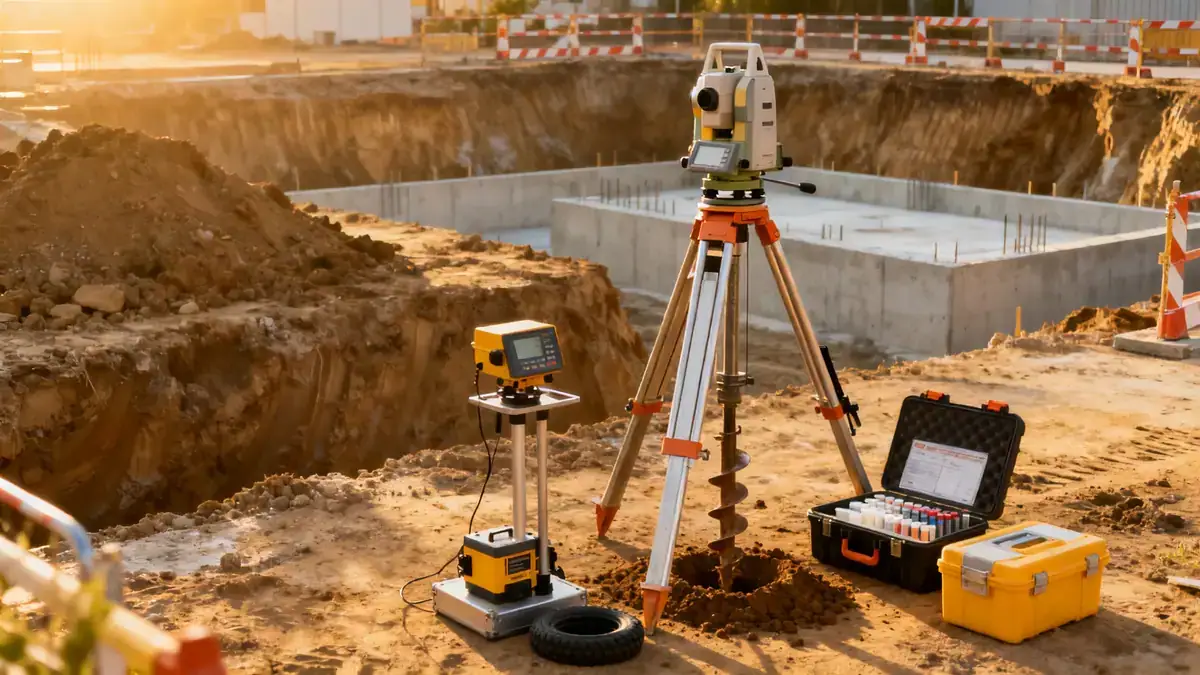
Our methodology for standard penetration test in Leeds follows ASTM D1586 and Eurocode 7 guidelines. We deploy truck-mounted or tracked rigs to access urban and suburban sites. Boreholes are advanced with continuous sampling at 1.0–1.5 m intervals, recording SPT N-values to assess relative density and strength. Field penetration tests are complemented by laboratory testing on disturbed and undisturbed samples. We provide comprehensive logs and interpretation, including N60 corrections and liquefaction potential assessment. For detailed profiling, we also offer cone penetration test (cpt) services.
Reference Technical Parameters
| Parameter | Reference Value |
|---|---|
| Predominant soil type | Glacial till (boulder clay), alluvial sands and gravels |
| Maximum seismic acceleration (PGA) | 0.05–0.10 g (low seismicity per UK National Annex) |
| Typical groundwater level | 2–6 m below ground surface (variable by season) |
| Bedrock depth | 10–30 m (Carboniferous Millstone Grit and Coal Measures) |
| Typical N60 range | 10–40 (glacial till); 5–20 (alluvial deposits) |
Local Considerations — Leeds
Leeds sits on Carboniferous bedrock overlain by glacial till and alluvium. Ground conditions vary significantly from the city centre (deep alluvial sequences) to suburban areas with shallow till. The groundwater table is generally shallow near the River Aire, requiring dewatering during excavations. Seismic hazard is low, but site-specific assessments may be needed for critical structures. Local geotechnical experience is essential to interpret SPT results in variable till. Our team also provides dpsh dynamic probing for rapid profiling in cohesive soils.
Request a Quote
Our team reviews your project and issues an initial report at no cost.
Or write us directly at [email protected]
Services in Leeds
Locations covered in Leeds
Applicable Standards
- ASTM D1586
- Eurocode 7 (BS EN 1997-2)
- UK National Annex to Eurocode 8
- BS 5930:2015 (Code of practice for ground investigations)
- NHBC Standards (residential foundations)
Frequently Asked Questions
What are the typical soil conditions encountered during standard penetration tests in Leeds?
Leeds primarily features glacial till (boulder clay) with variable cobble content, alluvial sands and gravels in valley bottoms, and occasional peat layers. SPT N-values typically range from 10 to 40 in till, with lower values in alluvial deposits. Groundwater is often encountered at depths of 2–6 m.
Is seismic assessment required for construction projects in Leeds?
The UK has low seismicity, but Eurocode 8 requires site-specific seismic response analysis for certain structures (e.g., hospitals, tall buildings). For most projects in Leeds, a basic assessment using the UK National Annex is sufficient. SPT data can be used for liquefaction potential evaluation in sandy alluvial soils.
Are geotechnical investigations mandatory for building permits in Leeds?
While not always mandatory, most local authorities and NHBC require a ground investigation for new builds or significant alterations. A standard penetration test is a common method to verify bearing capacity and settlement criteria, especially for residential foundations on till or alluvium.