
Methodology
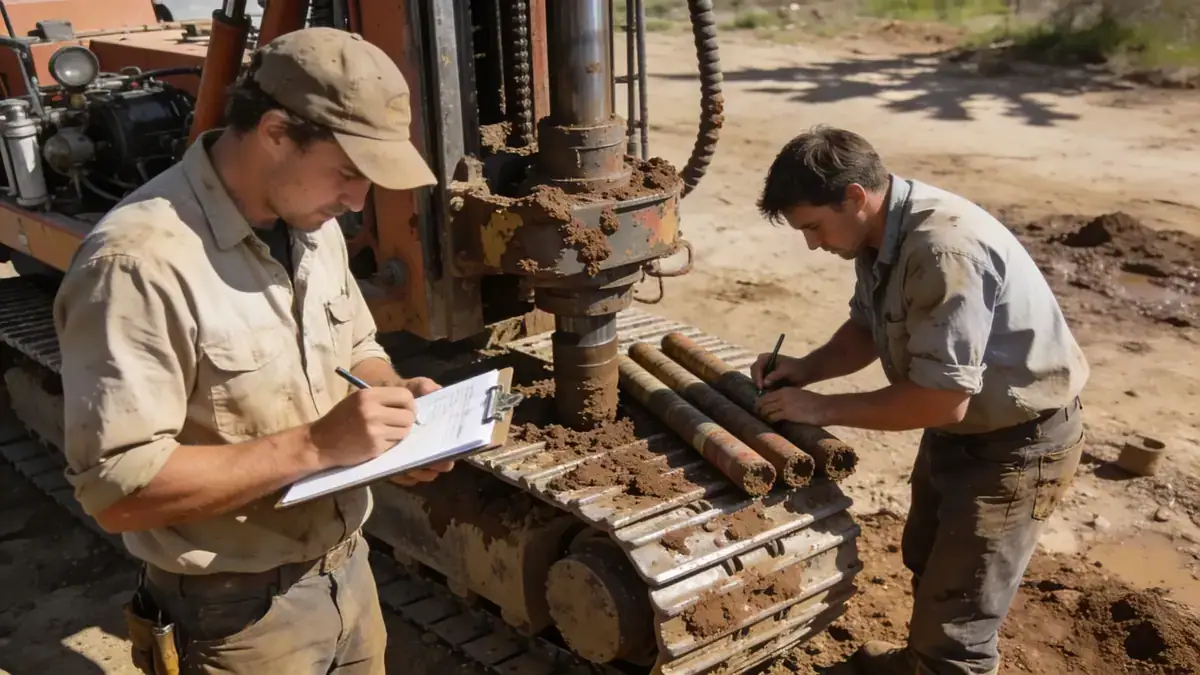
The Standard Penetration Test (SPT) is performed in accordance with BS EN ISO 22476-3:2005+A1:2011 and BS 1377-9:1990. A 63.5 kg automatic trip hammer is dropped from a height of 760 mm to drive a standard split-spoon sampler into the soil. The blow count (N-value) is recorded over three 150 mm increments, with the sum of the last two increments reported as the N-value. Our rigs are equipped with rope-pulley or automatic hammers calibrated to deliver 60-80% energy efficiency. Tests are typically performed at 1.0 m intervals to depths of up to 30 m, with continuous sampling in cohesive soils. Energy measurements are conducted using an instrumented rod to ensure compliance with ASTM D4633-16. Data is correlated with relative density (Dr) for sands and undrained shear strength (Su) for clays using established correlations (e.g., Peck, Hanson & Thornburn). For complementary dynamic probing, we also offer Cone Penetration Test (CPT) services.
Reference Technical Parameters
| Parameter | Reference Value |
|---|---|
| Hammer Energy Ratio (Er) | 60-80% (calibrated per BS EN ISO 22476-3) |
| Blow Count (N-value) | Range: 0-100 blows/300 mm |
| Sampler Dimensions | 35 mm ID, 51 mm OD, 610 mm length |
| Maximum Test Depth | 30 m (with NX-size rods) |
| Rod Diameter | 50 mm (A-rod) for depths < 15 m; 60 mm (B-rod) for greater depths |
Local Considerations — United Kingdom
Geotechnical conditions across the United Kingdom vary significantly, influencing the application of SPT. In Aberdeen, dense glacial till often yields high N-values requiring correction for overburden pressure. In Ashford, the presence of soft alluvial clays necessitates continuous sampling and careful interpretation of N-values for settlement analysis. Aylesbury's clay-with-flints deposits can cause sampler refusal, prompting alternative methods such as DPSH Dynamic Probing. Our team adapts the testing program to local geology, ensuring that N-values are properly corrected for energy efficiency, rod length, and overburden. We also consider seismic site classification per Eurocode 8, with SPT used to estimate Vs30 for sites in London, Manchester, and Edinburgh.
Request a Quote
Our team reviews your project and issues an initial report at no cost.
Or write us directly at [email protected]
Applicable Standards
- BS EN ISO 22476-3:2005+A1:2011
- BS 1377-9:1990
- ASTM D1586-11
- Eurocode 7 (BS EN 1997-2:2007)
Frequently Asked Questions
What is the difference between SPT N-value and corrected N60?
The raw N-value from the field is corrected for hammer energy efficiency to obtain N60, which represents the blow count for 60% energy. This correction allows for consistent correlation with soil properties across different rigs and operators. Our team applies energy measurements per ASTM D4633 to calculate N60 for all projects.
How is the SPT performed in cohesive soils?
In cohesive soils, the split-spoon sampler is still driven, but the N-value may not directly correlate with strength. Instead, undisturbed samples are retrieved for laboratory testing (e.g., unconfined compression). The SPT in clays is primarily used for stratigraphic logging and qualitative assessment of consistency.
What is the typical turnaround time for SPT results?
Preliminary N-values are reported within 24 hours of fieldwork. Final logs with corrected values, energy calibration data, and graphical plots are delivered within 5 working days. For projects requiring rapid assessment, we offer same-day preliminary reports via secure portal.
How much does Standard Penetration Test (SPT) cost in the United Kingdom?
Costs depend on site accessibility, test depth, number of tests, and mobilization distance. As a reference, a single SPT at 5 m depth with full energy calibration typically ranges from £150 to £300 per test. For a detailed quote tailored to your project, please contact our team with site specifics.