
Methodology
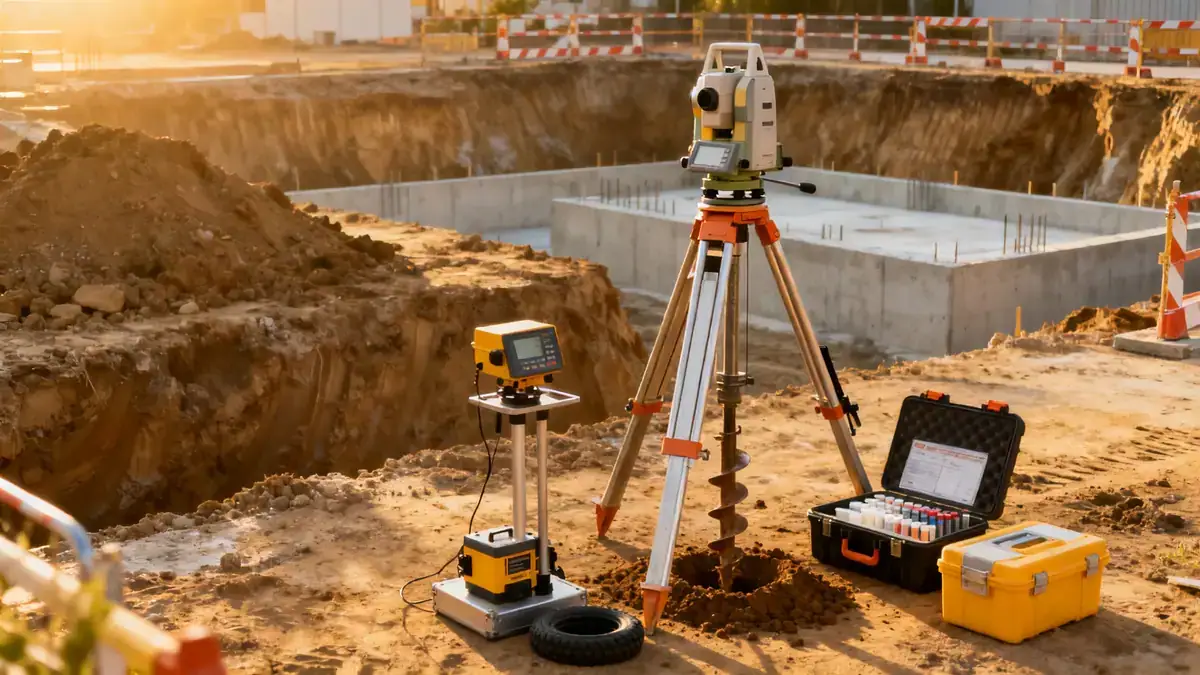
Our approach to standard penetration test (spt) in Swindon follows ASTM D1586 procedures, adapted to UK practice. We deploy a 63.5 kg hammer with a 760 mm drop to drive a split-spoon sampler. Blow counts are recorded over three 150 mm increments to obtain N60 values. Sampling intervals are typically 1.0 to 1.5 m, with continuous sampling in critical zones. Our rigs are equipped with automatic hammers to ensure energy efficiency and repeatability. Field data is correlated with local geology to adjust for overburden effects. For detailed service information, see our standard penetration test (spt) page.
Reference Technical Parameters
| Parameter | Reference Value |
|---|---|
| Predominant soil type | Oxford Clay / Corallian Limestone |
| Maximum seismic acceleration (PGA) | 0.05g to 0.1g (low seismicity) |
| Typical groundwater level | 3 to 8 m below ground surface |
| Bedrock depth | 5 to 30 m (limestone underlying clay) |
| Typical N60 range | Clay: 5–20; Limestone: 30–80 (variable) |
Local Considerations — Swindon
Swindon's geology features Oxford Clay overlying Corallian Limestone, creating a two-layer system. In northern areas, clay thickness exceeds 15 m, posing consolidation and shrink-swell risks. Southern zones have shallower limestone, offering higher bearing capacity. Groundwater is typically encountered at 3–8 m depth, requiring dewatering for deeper excavations. Seismic hazard is low (PGA < 0.1g per Eurocode 8), yet dynamic compaction may affect clay behavior. Our team has extensive experience addressing these conditions; for regional context, see our standard penetration test en Bristol services. We also integrate cone penetration test (cpt) for continuous profiling in clay layers.
Request a Quote
Our team reviews your project and issues an initial report at no cost.
Or write us directly at [email protected]
Services in Swindon
Applicable Standards
- Eurocode 7 (EN 1997-1 and EN 1997-2)
- BS 5930:2015 Code of practice for ground investigations
- ASTM D1586-18 Standard Test Method for Standard Penetration Test (SPT)
- Eurocode 8 (EN 1998-5) for seismic design
Frequently Asked Questions
What are the typical soil conditions encountered in Swindon?
Swindon's subsurface is predominantly Oxford Clay overlying Corallian Limestone. Clay layers can be soft to firm with N60 values of 5–20, while limestone yields N60 > 50. Groundwater is often encountered at 3–8 m depth.
Is seismic site classification required for Swindon projects?
Yes, per Eurocode 8, ground type classification is necessary even in low-seismicity zones. Swindon falls under ground types B or C depending on clay thickness, with PGA typically 0.05–0.1g.
Are standard penetration tests mandatory for building foundations in Swindon?
For most commercial and multi-storey residential projects, SPT is recommended to characterize bearing capacity and settlement. Local authorities may require ground investigation reports per BS 5930.