
Methodology
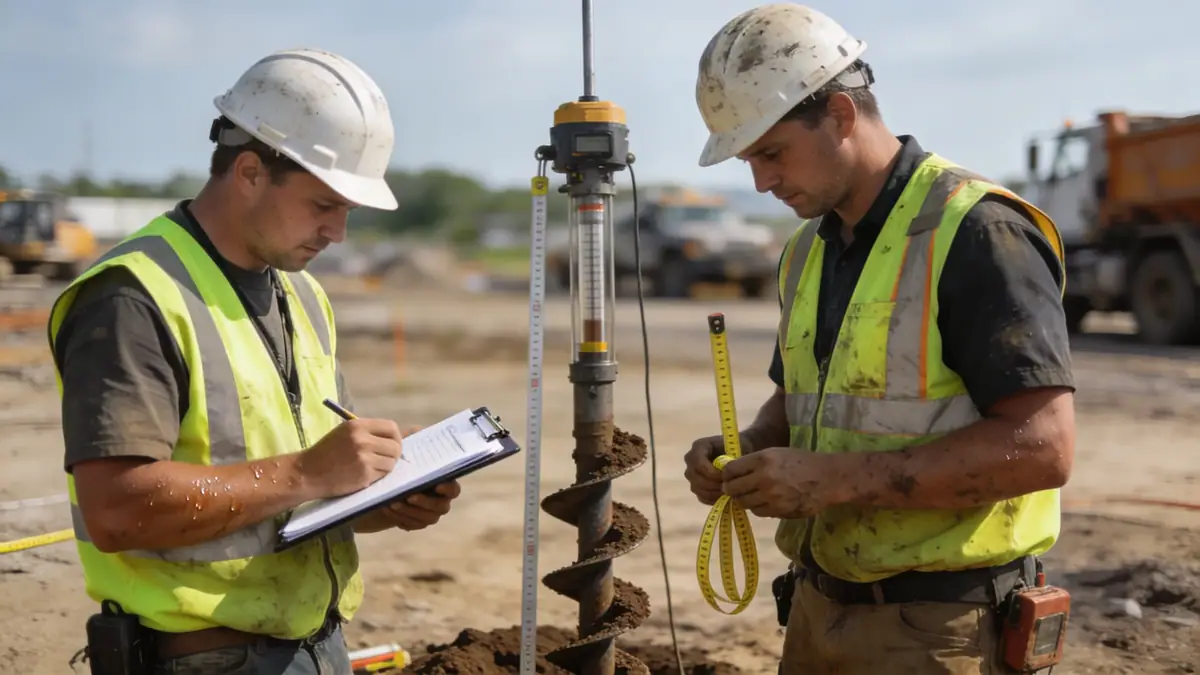
Our standard penetration test methodology in Northampton follows ASTM D1586 and BS 1377-9, using a 63.5 kg hammer falling 760 mm to drive a split-barrel sampler. We record blow counts per 150 mm increment to derive N-values, corrected for overburden and energy efficiency to N60. Boreholes are advanced to depths of 8–30 m depending on project requirements, with sampling intervals typically every 1.0–1.5 m. Continuous monitoring of groundwater levels and soil recovery is performed. For comprehensive profiling, we integrate SPT with cone penetration test (cpt) and dpsh dynamic probing as needed.
Reference Technical Parameters
| Parameter | Reference Value |
|---|---|
| Predominant soil type | Jurassic clay (Blisworth Clay, Upper Lias) with limestone bands |
| Maximum seismic acceleration (PGA) | 0.05 g (low seismicity per Eurocode 8) |
| Typical groundwater level | 2–6 m below ground surface |
| Bedrock depth | 10–30 m (Northampton Sand Formation) |
| Typical N60 range | 5–15 (clay), 20–40 (limestone/sandstone) |
Local Considerations — Northampton
Northampton's geology is dominated by Jurassic strata, including the Blisworth Clay, Upper Lias Clay, and Northampton Sand Formation. These clays are often overconsolidated but can exhibit high plasticity and shrink-swell potential, requiring careful moisture content assessment. Groundwater is typically encountered at 2–6 m depth, varying seasonally. Seismicity is low (PGA ~0.05 g), but Eurocode 8 still requires site classification via SPT N60 values. In central Northampton, fill and former industrial land may present obstructions or contamination, while suburban areas offer more uniform clay profiles. Typical projects include residential extensions, commercial developments, and road improvements, where SPT provides essential bearing capacity and settlement parameters.
Request a Quote
Our team reviews your project and issues an initial report at no cost.
Or write us directly at [email protected]
Services in Northampton
Applicable Standards
- ASTM D1586
- BS 1377-9
- Eurocode 7 (EN 1997-1)
- Eurocode 8 (EN 1998-1)
Frequently Asked Questions
What are the typical soil conditions encountered during standard penetration testing in Northampton?
Northampton's soils are predominantly Jurassic clays (Blisworth, Upper Lias) with occasional limestone bands. Clays are stiff to very stiff, with N60 values typically 5–15, while limestone/sandstone layers yield N60 of 20–40. Groundwater is generally shallow (2–6 m).
Is seismic site classification required for projects in Northampton under Eurocode 8?
Yes, despite low seismicity (PGA ~0.05 g), Eurocode 8 mandates site classification based on SPT N60 values. Our standard penetration testing provides the necessary data to classify ground types A–E, ensuring compliant foundation design.
When is standard penetration testing mandatory for construction in Northampton?
SPT is typically required for Building Regulations approval, especially for deeper foundations, piled structures, or sites with variable ground conditions. Local planning authorities may also request geotechnical reports for contaminated land or flood risk assessments.