Methodology
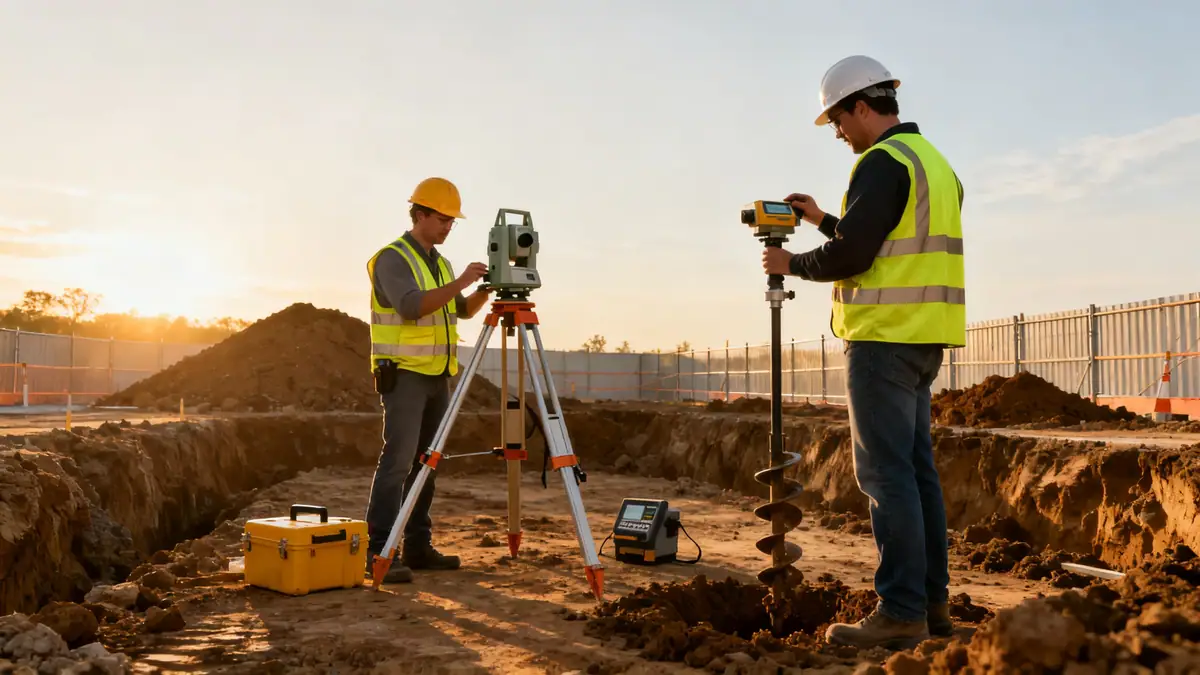
Our standard penetration test methodology in Dundee adheres strictly to ASTM D1586, with hammer energy calibration verified using a Pile Driving Analyzer to maintain N60 consistency. Boreholes are advanced using rotary coring or continuous flight auger to minimize disturbance. Sampling intervals are typically 1.0–1.5 m, with SPT performed at each change of stratum. We integrate SPT results with other in-situ tests, such as cone penetration test (cpt), to develop comprehensive geotechnical profiles. Our laboratory then correlates N-values with soil strength and deformation parameters per Eurocode 7 design approaches.
Reference Technical Parameters
| Parameter | Reference Value |
|---|---|
| Predominant soil type | Glacial till (boulder clay) overlying Old Red Sandstone bedrock |
| Maximum seismic acceleration (PGA) | 0.05–0.10 g (low seismicity, UK National Annex) |
| Typical groundwater level | 2–5 m below ground surface (variable with seasonal recharge) |
| Bedrock depth | 10–30 m (shallower in northern areas, deeper toward River Tay) |
| Typical N60 range | 15–40 blows/300 mm (dense till); 50+ in weathered bedrock |
Local Considerations — Dundee
Dundee's subsurface is dominated by glacial till (boulder clay) with variable cobble content, which can impede SPT advancement and requires careful energy correction. The presence of soft alluvial deposits along the Firth of Tay necessitates liquefaction assessment for certain developments. Groundwater levels fluctuate with tidal influence near the river. Our team adapts testing procedures to local conditions, including pre-drilling through fill and using larger diameter samplers where necessary. For broader regional context, our standard penetration test en Glasgow operations address similar glacial geology but with different depth and groundwater regimes.
Request a Quote
Our team reviews your project and issues an initial report at no cost.
Or write us directly at [email protected]
Services in Dundee
Applicable Standards
- ASTM D1586
- Eurocode 7 (BS EN 1997-2)
- BS 5930
- UK National Annex to Eurocode 8
Frequently Asked Questions
What soil types are commonly encountered in Dundee?
Dundee's subsurface primarily consists of glacial till (boulder clay) with varying sand, silt, and cobble content. Underlying this is Old Red Sandstone bedrock. In low-lying areas near the River Tay, soft alluvial deposits and estuarine silts may be present. Local fill from historical industrial activities is common in brownfield sites.
Is seismic design required for structures in Dundee?
According to Eurocode 8 and the UK National Annex, Dundee lies in a low seismicity region with a peak ground acceleration (PGA) of 0.05–0.10 g. However, certain structures (e.g., hospitals, high-rise buildings) may require site-specific seismic response analysis. Standard penetration test N-values are used to assess soil liquefaction potential and site classification.
Are geotechnical investigations mandatory for new developments in Dundee?
While not a statutory requirement for all projects, local building control and NHBC (for residential) typically require a minimum of boreholes with SPT to confirm bearing capacity and settlement criteria. Contaminated land assessments are often required for brownfield sites. Our firm provides SPT investigations to satisfy these requirements.