Methodology
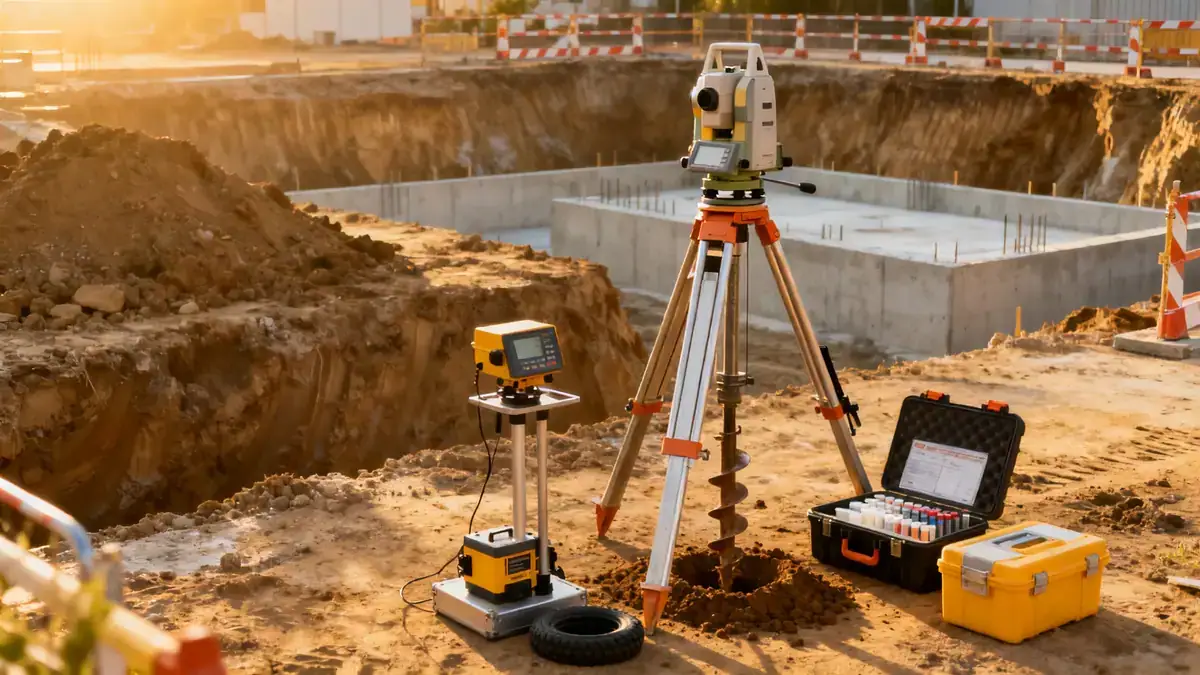
Our methodology for standard penetration tests in Bangor follows ASTM D1586, employing a 63.5 kg hammer dropped 760 mm to drive a split-spoon sampler. We record blow counts per 150 mm increment, with N-values corrected for overburden and energy efficiency. In cohesive soils, we obtain undisturbed samples for laboratory testing. Our approach integrates continuous sampling intervals of 1.0–1.5 m, achieving typical depths of 8–15 m for residential projects and up to 30 m for industrial structures. For detailed stratigraphic profiling, we complement SPT with cone penetration test (cpt) soundings.
Reference Technical Parameters
| Parameter | Reference Value |
|---|---|
| Predominant soil type | Glacial till (boulder clay) with sandy gravel lenses |
| Maximum seismic acceleration (PGA) | 0.15g (UK National Annex to Eurocode 7) |
| Typical groundwater level | 1.5–3.0 m below ground surface |
| Bedrock depth | 10–25 m (Ordovician mudstone/siltstone) |
| Typical N60 range | 15–35 (medium dense to dense till) |
Local Considerations — Bangor
Bangor's subsurface is dominated by glacial till deposited during the Devensian glaciation, with variable thickness and lateral heterogeneity. Along the Menai Strait, alluvial deposits and soft clays require careful handling to avoid disturbance. Seismic hazard is low (PGA ~0.15g per Eurocode 7), but liquefaction potential exists in loose sands near the coast. Elevated areas like Penrhosgarnedd feature shallow bedrock, while the city centre has deeper drift cover. Typical projects include coastal defences, university expansions, and housing developments, all requiring robust site investigation. For regional coordination, our standard penetration test en Cardiff hub supports larger projects across Wales.
Request a Quote
Our team reviews your project and issues an initial report at no cost.
Or write us directly at [email protected]
Services in Bangor
Applicable Standards
- ASTM D1586
- Eurocode 7 (BS EN 1997-2)
- BS 5930:2015
- UK National Annex to Eurocode 8
Frequently Asked Questions
What soil types are commonly encountered in Bangor during SPT investigations?
Bangor's geology is primarily glacial till (boulder clay) with interbedded sands and gravels. Coastal areas may contain soft alluvial clays and peat. Bedrock consists of Ordovician mudstone and siltstone, typically encountered at depths of 10–25 m.
Is seismic design required for foundations in Bangor according to UK regulations?
Yes, Eurocode 8 applies to all UK construction. Bangor falls in the low seismicity zone with a PGA of 0.15g. Site-specific response spectra are required for important structures, and SPT N-values are used to assess liquefaction potential in loose granular soils.
Are standard penetration tests mandatory for building permits in Bangor?
While not explicitly mandatory, local authorities typically require a geotechnical report for new builds and significant alterations. SPT is the preferred method for determining bearing capacity and settlement parameters, especially in variable glacial till.